Only God Attended His Funeral
Thursday, December 21, 1899, after cutting short a Kansas City crusade and returning home in ill health, D. L. Moody told his family, "I'm not discouraged. I want to live as long as I am useful, but when my work is done I want to be up and off." The next day Moody awakened after a restless night. In careful, measured words he said, "Earth recedes, Heaven opens before me!" His son, Will, concluded his father was dreaming. "No, this is no dream, Will. It is beautiful. It is like a trance. If this is death, it is sweet. There is no valley here. God is calling me, and I must go."
In Deuteronomy the Israelites are at the border of the long-awaited inheritance that God had sworn with uplifted hand to give to Abraham descendants (Exod.6:8). The old generation that disobeyed God had perished in the wilderness (Joshua 5:6). Moses had pleaded with the LORD to let him cross the Jordan River and see the Promised Land. The Lord said No! You will see the land only from a distance; you will not enter (Deut. 3:25-27; 32:49-52).
Moses could have become bitter because of God's prohibiting him from entering the Promised Land, but he accepted the verdict without bitterness. He did not complain about it, or even prayer against it. He entirely submitted to the will of God and prepared to hand over. The book of Deuteronomy records the last instructions that Moses gave to the Israelites and his handing over process. The book is framed between the announcement of Moses’ impending death (chapter 3) and the announcement of his actual death (chapter 34).
Moses made one more prayer for the people he loved. He said, “may the Lord, the God who gives breath to all living things, appoint someone over this community...so the Lord’s people will not be like sheep without a shepherd” (Num.27:12-17). So the Lord said to Moses, “commission Joshua, and encourage and strengthen him, for he will lead this people (Deut.3:28). Lay your hand on him. Have him stand before Eleazar the priest and the entire assembly and commission him in their presence” (Num.27:18-23).
Moses went out and spoke these words to all Israel: “The Lord your God himself will cross over ahead of you...Joshua also will cross over ahead of you (Deut.31:1-3). He laid hands on Joshua as the Lord commanded. This was public so all Israel could see and understand that Joshua was the chosen leader. Eleazar was present ; he was Aaron son who had taken over from his dead father (Num.20:28). Moses did all that remained to be done and then went willingly to his end.
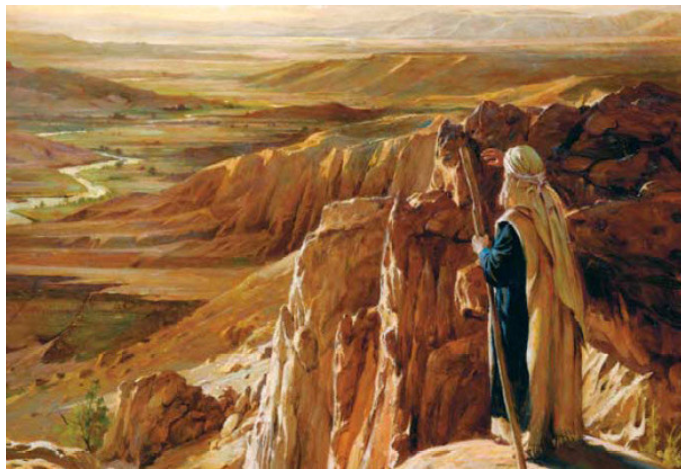
Moses climbed Mount Nebo from the plains of Moab to the top of Pisgah, across from Jericho. There the Lord showed him the whole land... said to him, “This is the land I promised on oath to Abraham, Isaac and Jacob when I said, ‘I will give it to your descendants.’ I have let you see it with your eyes, but you will not cross over into it” (Deut. 34:1-4). Moses' ascent to Mount Nebo was an act of obedience, even though he knew he was going to there to die.
Pisgah’s geographical location provided a vantage point to view the Promised Land. The view offered Moses a perspective that transcends immediate circumstances- the wonderful future. Pisgah represented the culmination of Moses' earthly journey and leadership. The act of seeing served as a moment of closure for Moses. The mountain's height symbolized the spiritual heights Moses reached in his relationship with God.
The phrase “land promised by God to Abraham and his descendants” symbolizes God's faithfulness and the fulfilment of His promises (Gen. 15:18-21). This act of seeing Canaan is both literal and symbolic. After seeing the land, Moses verified that God had kept His word to Abraham. It signified the transition from promise to possession. God's plans are not thwarted by human failure. His promises are sure, even if we do not see their complete fulfilment in our lifetime.
“Moses the servant of the Lord died there in Moab, as the Lord had said. He buried him in Moab, in the valley opposite Beth Peor, but to this day no one knows where his grave is. Moses was a hundred and twenty years old when he died, yet his eyes were not weak nor his strength gone. The Israelites grieved for Moses in the plains of Moab thirty days, until the time of weeping and mourning was over” (Deut. 34:5-8).
The death of Moses may have seemed like a great calamity. His father and his grandfather had lived beyond that age (Exod. 6:16-20). The mental and spiritual powers of Moses were greater in the latter days of his life than ever before. It seemed a sad loss for the people of Israel. It would need all the faith and discretion of Moses to conduct the conquest of the Canaan, and to divide the land among the tribes. Yet precious as his life was, God said “you will not enter the land”.
Moses was one of the greatest men to ever walk this earth. But, he was not irreplaceable. Israel would still be in good hands, with or without Moses. Moses' death serves as a reminder of the inevitability of death for all people encouraging believers to live with an eternal perspective. Crossing Jordan is a type of the transition from earthly life to eternal rest. Entering heaven, the place of eternal rest, is longing for all believers.
Despite his advanced age, Moses maintained his physical vitality, as his eyes were not dim nor his natural force diminished. God kept Moses physically strong and his eye sight clear so that at the end of his life he would go up to the top of Pisgah and look west and north and south and east with his own eyes (Deut. 3:27). The timing and manner of Moses' death were determined by God, illustrating His sovereignty over life and death.
Moses is distinguished as “the servant of the Lord”. He was a true servant of God from the time when he was appointed at the burning bush until the hour when he surrendered his keys of office to his successor at Moab. Heb 3:1-5 says “Jesus ... was faithful to the one who appointed him, just as Moses...Moses was faithful as a servant in all God’s house, bearing witness to what would be spoken by God in the future”.
Moses died without seeing the full result of his life-work. Another man would finish the job that he had started. Many of God’s servants die before the task which they had in view is fully accomplished. King David died before building the Temple, his son Solomon did it. Paul wanted to take the gospel across Europe but he had to hand over to Timothy. It is true that we are immortal till our work is done; but then we usually think that our work is something other than it is.
It was Moses wish, but not his work, to lead Israel into the Promised Land. Moses did finish his own work; but the desire of his heart was to have seen the people settled in their land; and this was not granted him. He was ordered to deliver the people from Egypt and lead them through the wilderness and he had done so. At the point of his death they were on the borders of their heritage, a people moulded by his hand; a regenerated race, far more fitted than their fathers to become a nation.
Moses’ death was the climax of his life; no man has ever had the honours which surrounded his departing hours. God sets both the place and the moment of Moses’ death. He died when, where and how God determined (Job 14:5). He died, in the best company possible-in the presence of God. He was buried by God in a secret grave. Pisgah was to him the vestibule of heaven. God met him at the gates of Paradise. Nobody else has ever had such a burial.
Entering Canaan was the strongest desire of Moses’ soul in regard to anything earthly. It was not granted but something far better and lasting was waiting for him across the river of death. His longing reinforces our anticipation of the ultimate, promised (1 Pet.1:3-5;1 Cor. 2:9). God’s purposes outstrip temporal rewards; faithfulness is never wasted.
Moses’ mountain vista anticipated the fuller vision he would later enjoy at the Transfiguration (matt.17:1-3). There, Moses finally stands on a mountain in the Promised Land with Elijah and the glorified Christ, proof that God’s ‘no’ in time can become a greater ‘yes’ in eternity. (Matthew 17:1–3). Although Moses only viewed the promised land before his death, he stands in it, a tangible illustration that all of God’s promises are “yes” (2 Cor. 1:20).
Heb 11 speaks of “people were still living by faith when they died. They did not receive the things promised; they only saw them and welcomed them from a distance, admitting that they were foreigners and strangers on earth. ..they are looking for a country of their own. .. they were longing for a better country—a heavenly one..... These were all commended for their faith, yet none of them received what had been promised, since God had planned something better for us so that only together with us would they be made perfect”.
Moses was a song writer. Psalm 90 is the oldest of the Psalms; it’s titled “A prayer of Moses the man of God”. In this Psalm Moses sings of the frailty of man, and the shortness of life, contrasting it with the eternity of God. The song (Psalm) ends with these words, “Satisfy us in the morning with your unfailing love, that we may sing for joy and be glad all our days... May your deeds be shown to your servants,your splendor to their children... establish the work of our hands for us, yes, establish the work of our hands (Ps.90:14-17)
Moses prayer was that the work of his hand may be established; that its impact may endure and be seen in the next generation. This prayer was answered. Though the first generation perished in the wilderness, the second generation was the most devoted to God of any generation that Israel ever saw. It’s about them that God said “‘I remember the devotion of your youth, how as a bride you loved me and followed me through the wilderness, through a land not sown. Israel was holy to the Lord, the first fruits of his harvest (Jer.2:2-3).
Balak the king of Moab sought to curse this generation through Balaam non-Israelite prophet but failed. Balaam said “how can I curse those whom God has not cursed? ...From the rocky peaks I see them, from the heights I view them. I see a people who live apart and do not consider themselves one of the nations. Who can count the dust of Jacob or number even a fourth of Israel? Let me die the death of the righteous, and may my final end be like theirs!”(Num.23:8-10).
In Deuteronomy 31:14, the Lord said to Moses, “Now the day of your death is near... Now write down this song and teach it to the Israelites and have them sing it. Deuteronomy 32 records that song it was Moses last song. Part of the song says “I will proclaim the name of the Lord. Oh, praise the greatness of our God! He is the Rock, his works are perfect, and all his ways are just. A faithful God who does no wrong, upright and just is he (vv.3-4).
Years later prophet Isaiah wrote similar words “Lord, you are my God; I will exalt you and praise your name, for in perfect faithfulness you have done wonderful things, things planned long ago (Isa. 25:1). Moses describes God as "the Rock," strong , unchangeable and permanent. The image of God as a rock underscores His eternal presence, contrasting with the shifting sands of human frailty.
Moses declares that God's work is perfect. This teaches us to trust in His plans and purposes, even when we do not understand them fully. Moses not only made it to heaven but his work followed him there (Rev. 14:13). In his vision, the Apostle John saw “ those who had been victorious over the beast .They held harps given them by God and sang the song of God’s servant Moses and of the Lamb.“ (Rev.15:2-4).


Comments
Post a Comment