How God Launched Global Mission
While Dr. R A Torrey was at Moody Bible Institute in Chicago,he announced a week of prayer. At the close of that prayer week someone asked “why not continue this prayer for a mighty revival throughout the world?” Dr Torrey wrote this about the incident, “I consulted the faculty and they all agreed. We prayed one night a week; at first three to four hundred people met to pray for a worldwide revival.
This prayer continued in a small circle the entire night. God in a marvelous manner began to move. On one of the mornings following those night prayer meetings, Dr Torrey preached in the auditorium of the institute. Two gentlemen asked if he could go to Australia and conduct a Bible campaign. Dr Torrey answered yes. He wired Charles Alexander a famous gospel singer to meet him in Japan.
There a remarkable outpouring of the Holy Spirit upon the Japanese people began. Some ten thousands were converted. When he arrived in Australia Dr Torrey discovered that his book “how to pray” had preceded him. After reading the book a lady was struck with the thought of “pray through” which Dr Torrey emphasized in one of the chapters. She asked a number of friends to join her in prayers.
Thirty people assembled and prayed for a worldwide revival. With time two thousands prayer circles were organized in Australia. In three and a half years, one hundred thousand souls were won to God. More glorious is the fact that in scores of places on mission fields, revival showers broke out from the spiritual overflow of the Australian, Japanese and British campaigns.
In Acts 12 we are told that a Prophets went to Antioch from Jerusalem and predicted a severe famine. The disciples at Antioch decided to help the brethren living in Judea. They sent their gift to them by Barnabas and Saul (Acts 11:27-30). While Barnabas and Saul were in Jerusalem, Herod had James put to death but God miraculously rescued Peter from him. Then Barnabas and Saul returned to Antioch from Jerusalem, taking with them John, also called Mark.
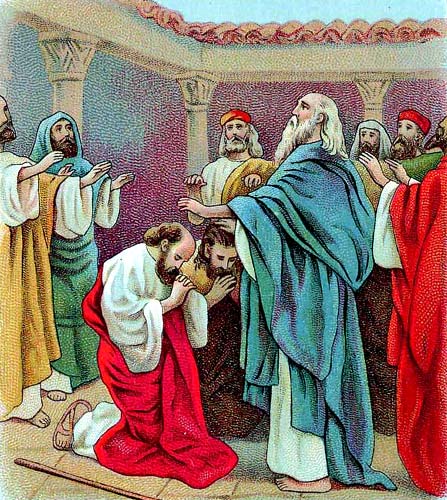
Acts 13:1-6 says “now in the church at Antioch there were prophets and teachers: Barnabas, Simeon called Niger, Lucius of Cyrene, Manaen (who had been brought up with Herod the Tetrarch) and Saul. While they were worshiping the Lord and fasting, the Holy Spirit said, ‘Set apart for me Barnabas and Saul for the work to which I have called them.’ So after they had fasted and prayed, they placed their hands on them and sent them off”. The two of them, sent on their way by the Holy Spirit, went down to Seleucia and sailed from there to Cyprus”.
Before Jesus ascended into the heavens, he said to his disciples, "You shall receive power after the Holy Spirit is come upon you, and you will be my witnesses ". Then he outlined geographically how that witness should proceed, beginning in Jerusalem, then in Judea and Samaria, and finally unto the uttermost parts of the earth (Acts 1:8). Acts 13 marks the beginning of the third phase- the going unto the uttermost parts of the earth. The rest of Acts traces that journey.
From Antioch, Paul and his helpers will carry the Gospel throughout the then-known world. This is also the beginning of the apostleship of Paul. Up to this time, though he was called to be an apostle when he was first converted on the Damascus road, he has never acted as an apostle. Now, some eleven or twelve years after his conversion, he begins to fulfil the ministry to which he was called as an apostle of Jesus Christ.
In the church at Antioch there were prophets and teachers. Prophets in the early church were individuals who received revelation from God, often providing guidance and encouragement. Teachers were responsible for instructing the church in doctrine and Bible teachings. The presence of both roles indicates a well-established and spiritually mature church, capable of discerning and spreading the Gospel.
Acts 13 lists the names of the prophets and teachers who were leaders in the church at Antioch. Barnabas a Hellenistic Jew and a Levite born in Cyprus (Acts 4:36). He was well-respected by the apostles (Acts 9:27; 11: 22-24). Simeon, also known as Niger, which means "black", suggesting he may have been of African descent. His inclusion in the church leadership reflects diversity and inclusivity, breaking down ethnic and cultural barriers.
Lucius was from Cyrene in North Africa; it was men from Cyprus and Cyrene who first brought the gospel to Antioch (Acts 11:20). Manaen and Herod the tetrarch grew up together. This indicates that Manaen was likely of noble or influential background. It is interesting that these two men, raised in the same setting, would go in such opposite directions. Herod killed John the Baptist (Luke 3:19-20; Matt.14:10) and presided over one of the trials of Jesus (Luke 23:6-12).
Manaen became a Christian and a leader in the church at Antioch. His conversion and leadership in the church highlight the transformative power of the Gospel, reaching even those connected to political power. Saul was a former Pharisee and persecutor of believers. He studied at the feet of Gamaliel (Acts 22:3). This thorough training in Jewish law and his Roman citizenship uniquely equipped him for his missionary work.
The church at Antioch exemplified diversity. The five leaders in the church represented a broad racial, cultural, educational and socio-economic range. This is a reflection of the inclusive nature of the Gospel and the unity found in Christ. The diverse backgrounds of these leaders also demonstrate that God can use anyone, regardless of their past or social standing, for His purposes.
A church with five very different leaders became the first to send missionaries across continents. God launched global mission through this team. Diversity is designed to glorify Christ and advance His gospel. Diversity, not only in leadership but also in the congregation gives the church great strength. Unity across backgrounds pictures the gospel’s target. Revelation 5:9 says “with his blood Jesus purchased for God, persons from every tribe and language and people and nation”.
Five very different people were seeking God together. This was part of what happened at the early church. The members devoted themselves to four things: apostle’s teachings, fellowship, breaking of bread and prayer (Acts 2:42-47). Their leaders devoted themselves to prayer and ministry of the word (Acts 6:4). Does the today’s church follow their examples and with the same results?
While these men were seeking God in worship and fasting, the Lord gave them a history-changing directive. The beginnings of the great missionary journeys of Paul, which transformed the Roman world, began in a prayer gathering. God spoke to these men while they were doing their routine service. Some Christians think that they should sit idle until God tells them what to do. Special guidance, if required, usually comes while we are engaged in some ministry.
The Holy Spirit said, “set apart for me Barnabas and Saul for the work to which I have called them.” It is significant that these two men were, as far as we know – the two most gifted in the congregation. Saul and Barnabas did not volunteer. The church did not choose Saul and Barnabas. They would probably have been the last two chosen, since they were the best the church had. The Church was told to sacrifice their best people to facilitate God’s plans.
The Holy Spirit sovereignly called Saul and Barnabas to missionary service. God not only sovereignly chose the men He wanted to be His missionaries but He chose the work they were to do. God always gets the right people in the right places when He has a work He wants to do in this world. Paul would later write in Ephesians 2:10 “For we are His workmanship, created in Christ Jesus for good works, which God prepared beforehand that we should walk in them”.
Luke does not explain exactly how the Holy Spirit spoke; possibly he spoke through one of the prophets. How he did it was less important to Luke than that he did it. Whatever method he used, there was clear communication from God to these men. If Luke had revealed just how the Spirit gave this "missionary call," every missionary candidate that followed might expect exactly the same type of leading. God leads His people though a variety of means that they can identify as His leading.
The Spirit did not specify where Barnabas and Saul were to go, nor did He indicate precisely what their entire future ministry would be. God’s guidance was only for the next step. God guides us on a “need to know” basis. He does not unfold the entire plan before us; He reveals the next step for us. Our obedience to that next step will open the door to further guidance, as it is required.
How, then, were Barnabas and Saul or the church to know what that ministry would be? First, God told Paul about his future ministry when he was saved. He knew about God’s calling him to be a missionary to the Gentiles many years before this commission. The Lord had said to Ananias that Saul “is my chosen instrument to proclaim my name to the Gentiles and their kings and to the people of Israel” (Acts 9:15-16). No doubt, Ananias relayed those words to Saul.
Later, Paul tells how when he first returned to Jerusalem after his conversion, he was praying in the Temple when he fell into a trance. The Lord told him to get out of Jerusalem, saying, “I will send you far away to the Gentiles” (Acts 22:17-21). Time had come for that now. Secondly, they knew what they were to do because they were already doing it and doing it exceedingly well (Acts 11:23-26). That is obvious by the growth and maturity of the church, as indicated by the leaders that are named.
After they had fasted and prayed, they placed their hands on them and sent them off. The two of them, sent on their way by the Holy Spirit, went down to Seleucia and sailed from there to Cyprus. This was the beginning of Paul's first missionary journey. The Church at Antioch sent Barnabas and Saul off; but more importantly, the Holy Spirit sent them on their way. Any group of Christians can send someone, but if the Spirit does not send them, it will not amount to an eternally effective ministry.
The church in Antioch sent Barnabas and Saul off. As far as we know, this had never happened before in the history of the Church. Many had gone out because of persecution (Acts 8:4;11:19) but there was never a concerted and organized effort to win people to Jesus like this. This is regarded as the first real known missionary effort of the Church. “The word ‘missionary’ has to do with sending. For the first time the church responded to God’s call to serve Him in the mission fields.
The leadership of the church at Antioch was able to discern the Holy Spirit’s leading because they were actively engaging God and seeking his direction through the spiritual disciplines of fasting and prayer. The churches today need to seek God’s direction about their specific role in the Great Commission. Church membership and leadership should reflect the diversity Christ envisioned (1 Cor. 12:12-14). They should involve different cultures and classes; their perspectives sharpen outreach strategy.
Have you ever felt the Holy Spirit prompting you to a particular area of ministry or outreach? How can you engage God in such a way that you are sensitive to the movement of the Holy Spirit in your life? God is calling us to specific works in order to expand his kingdom on earth. Watchman Nee, a Chinese Christian author wrote “God will bless what He initiates, what depends on Him for its success, what is done according to His Word and what is done for His glory”.


Comments
Post a Comment