Paul's Second Missionary Journey
When Dwight L. Moody was in London during one of his famous evangelistic tours, several British clergymen visited him. They wanted to know how and why this poorly educated American was so effective in winning throngs of people to Christ. Moody took the three men to the window of his hotel room and asked each in turn what he saw. One by one, the men described the people in the park below. Then Moody looked out the window with tears rolling down his cheeks.
"What do you see, Mr. Moody?" asked one of the men. "I see countless thousands of souls that will one day spend eternity in hell if they do not find the Savior." D. L. Moody saw people differently than the average observer does. And because he saw eternal souls where others saw only people strolling in a park, Moody approached life with a different agenda (Today in the Word, 1997).
The book of Acts records the missionary works of the early Church. In Acts15:39-41 Paul said to Barnabas, “Let us go back and visit the believers in all the towns where we preached the word of the Lord and see how they are doing.” Barnabas wanted to take John, also called Mark, with them, but Paul did not think it wise to take him, because he had deserted them in Pamphylia ... They had such a sharp disagreement that they parted company. Barnabas took Mark and sailed for Cyprus, but Paul chose Silas and left.”
Paul knew they would face the same kind of difficult circumstances, perhaps even worse. They were going into places where they would face opposition, persecution, hardship and even death. He needed someone he could fully depend on. Barnabas looked at his young cousin and thought “we serve a God of grace and second chance”. Even if Mark had turned away when things got rough, Barnabas saw real potential in him. He refused to write him off even though he had failed.
Pau was right; the mission field was not for the weaklings. Barnabas was right about Mark. The young man eventually won the trust of Peter (1Pet.5:13).He wrote the book of Mark which is said to be the first of the four gospels to be written. Paul later added Mark to his evangelistic team (Col.4:10) and even acknowledged him as “helpful to me in my ministry”(2 Tim.4:11). How interesting that at the end of his "journey" Paul describes Mark in a similar way just as Luke had described him at the beginning of their first missionary journey. He wrote “John was with them as their helper” (Acts 13:5).
Luke does not include anything more about Barnabas or his travels after this. He does not record the missionary works and achievements of Barnabas and mark. But God has the record well kept in his book of works. Believers are assured that nothing done for Christ is wasted. Scripture affirms that “those who go out weeping, carrying seed to sow, will return with songs of joy, carrying sheaves with them” (Ps.126:6). Paul looked forward to the return of Christ, when faithful believers would stand before the Lord as evidence of His work.
He anticipated standing alongside the Corinthian believers before God. He wrote to them “we know that the one who raised the Lord Jesus from the dead will also raise us with Jesus and present us with you to himself” (2 Cor. 4:14). He asked the Thessalonians “what is our hope, our joy, or the crown in which we will glory in the presence of our Lord Jesus when he comes? Is it not you? Indeed, you are our glory and joy”(1Thess 2:19-20). He called the Philippians “my joy and crown” (Phil. 4:1).
Revelation 22:12 says “blessed are the dead who die in the Lord ... that they may rest from their labors; for their works follow with them” . “Each one will receive his due for the things done in the body” (2Cor. 5:10). Isaiah 3:10 says “tell the righteous it will be well with them, for they will enjoy the fruit of their deeds”. Isaiah 40:10 says “behold, the Lord GOD comes ... His reward is with Him and His recompense accompanies Him”. Believers will be rewarded for everything they have done for the Lord. They will also be compensated for all the damages they suffered in the service of the Lord.
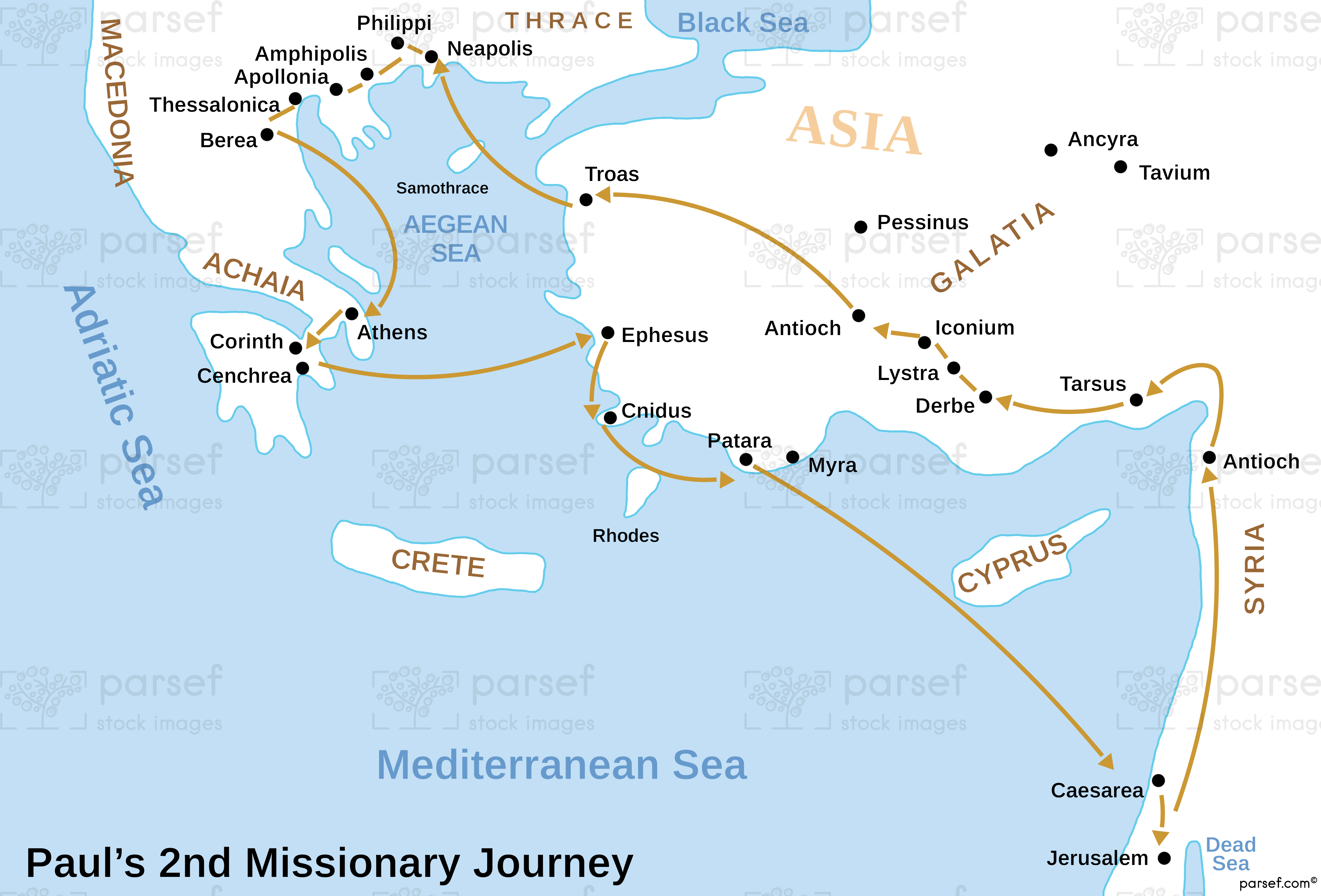
After being commended by the believers to the grace of the Lord, Paul accompanied by Silas began his second missionary journey (Acts 15:36-18:22). Silas was a Jew and a Roman citizen (Acts 16:37). He was one of the leading men in the Jerusalem Church and a prophet (Acts 15:22, 32). Silas was in every respect an excellent companion for Paul missionary work. As a Jew, he had entrance into the synagogues. As a Roman citizen, he enjoyed the same protection and benefits as did Paul. As a prophet he would use his gift in the work.
When sent by the Jerusalem council to the Antioch church “Judas and Silas spoke at length to the believers, encouraging and strengthening their faith” (Acts 15:32). He would do the same in other churches. Silas status as a respected leader of the Jerusalem church would reinforce Paul’s teaching that salvation was solely by grace. If any of the Christian Jews should say that Paul was mistaken about circumcision, Silas would be there, a messenger from the church at Jerusalem, to confirm the position of the Church. In every way, God had the right man for the right job.
In the first missionary journey, Paul and Barnabas first headed south west by sea to Cyprus and then north by sea to Perga, Antioch of Pisidia, Iconium, Lystra and Derbe. This time they go north towards the great ridge of the Taurus Mountains. To reach the plateau and the cities beyond they had to pass over great ridge, a hard journey of several days. Paul and Silas traversed Syria and Cilicia, strengthening the infant churches. Tarsus, Paul’s hometown, was a city was in Cilicia.
These churches in Syria and Cilicia were probably planted by Paul during his ten silent years (Acts 9:30-11:25-26). Strengthening the infant churches seems to be Paul's practice; he re-traced his steps during the first missionary journey. We read that he and Barnabas were "strengthening the souls of the disciples, encouraging them to continue in the faith” (Acts 14:22). The act of strengthening the churches involved teaching, encouraging, and ensuring that the doctrine remained pure.
This was crucial in a time when false teachings and divisions could easily infiltrate the young Christian communities. Paul's role as an apostle was not only to plant churches but also to nurture and guide them towards spiritual maturity. His encouragement caused them to grow strong and firm in the faith and in their commitment to Christ. It also gave them increased resolve to hold fast to the Word, especially when facing adverse circumstances and difficulties.
“Paul came to Derbe and then to Lystra, where a disciple named Timothy lived, whose mother was Jewish and a believer but whose father was a Greek. The believers at Lystra and Iconium spoke well of him. Paul wanted to take him along on the journey, so he circumcised him because of the Jews who lived in that area, for they all knew that his father was a Greek" (Acts 16:1-3). Derbe had been the furthest extension east on the first missionary journey. On Paul's first trip to Derbe he approached the small city from the east, coming from Lystra. Now he approaches it from the east.
On the first missionary journey Paul and Barnabas had great success in Derbe. They had won many disciples there (Acts 14:20-21). Paul would feel very much at home when he reached Derbe. The brethren would rejoice to see him and to make the acquaintance of Silas, his new companion. In the next town,Lystra, Paul met a disciple called Timothy. This is the man to whom, years later, Paul wrote two epistles- 1 and 2 Timothy.
Timothy’s mother
and grandmother had trained him well in the Old Testament Scriptures. Such instruction
fulfilled the pattern given to Israel, where God’s words were to be taught
diligently within the family and woven into daily life. God had
commanded the parents “fix these words of mine in your hearts and minds... Teach
them to your children, talking about them when you sit at home and when you
walk along the road, when you lie down and when you get up” (Deut. 6:6–7;11:18-19). Timothy's mother had obeyed God and Timothy's life was shaped by the Scriptures.
In his last letter Paul recalls how Timothy had become a believer writing “ I am reminded of your sincere faith, which first lived in your grandmother Lois and in your mother Eunice and I am persuaded, now lives in you also (2 Tim. 1:5). Continue in what you have learned and have become convinced of...from infancy you have known the Holy Scriptures (2 Tim. 3:14-15). The Old Testament Scriptures had prepared Timothy to received the gospel, probably from Paul's in the previous missionary trip to Lystra. Paul referred to him as his son (1 Tim. 1:2;2 Tim. 1:2;1 Cor. 4:17).
Timothy inherited a rich legacy of faith that helped to prepare him for his calling. Paul wanted to take him along so he circumcised him (Acts 16:3). Paul had recently been in a conference of the church in which he had opposed the contention that circumcision was necessary and now was teaching that doctrine to all the churches where he went. Nevertheless, as a matter of expediency, that he might become all things to all men (1 Cor.9:19-23), he advised Timothy to be circumcised so that there might be no obstacle to the admission of his young assistant to Jewish synagogues.
Timothy also received a gift; years later Paul wrote to him, “do not neglect your gift, which was given you through prophecy when the body of elders laid their hands on you" (I Timothy 4:14). Paul recognized that the source of all power is in the Holy Spirit. Timothy had earned a splendid reputation in his home town of Lystra and even as far as Iconium (Acts 16:2). He would now become the pleasing aroma of Christ wherever he goes (2 Cor.2:14-16). It’s likely that Paul prayed for guidance and was led to seek out this man for his missionary service.
Timothy would have had no delusions of grandeur about some great, exciting missionary adventure, for he had either witnessed firsthand or had certainly heard the stories about Paul being stoned for preaching the Gospel. Timothy would have counted the cost of partnering with Paul and yet it did not deter him from joining the team. He became a preacher and a missionary greatly valuable in the spread of the gospel and the growth of the early Church. He was dearly loved by the apostle Paul and considered indispensable in ministry (Phil.2:22).
Paul was well aware of the necessity of training a new generation for the work and for the days that lay ahead. He was a mentor, entrusting ministry responsibilities to Timothy and viewing him as the successor to his own legacy of ministry. Timothy was his faithful and almost constant companion, through the remainder of his life and work. The missionary team "traveled from town to town, they delivered the decisions reached by the apostles and elders in Jerusalem for the people to obey. So the churches were strengthened in the faith and grew daily in numbers" (Acts 16:4-5).
The letter written by the Jerusalem council was
addressed to the Gentile believers in Antioch, Syria and
Cilicia (Acts 15:23). But, the message was meant for all gentile churches. The churches grew, as they ought always to do, as the result of
work and faith. Strong
churches, established in the faith, will naturally increase in numbers. Although there were
many difficulties and in some cases persecutions, the believers maintained
their faith and many more joined them.
It’s interesting to note how quickly Barnabas is replaced by Silas and John Mark is replaced by Timothy. We should always keep in mind, how quickly and how easily any of us can be replaced, especially if we think of ourselves as indispensable. This is an example of how God, like a skillful coach, places just the right players on the field for what He has in mind. Barnabas was just the right teammate for Paul on the first missionary journey. Likewise Silas and Timothy and Luke were the right teammates for the second missionary journey.


Comments
Post a Comment