The Jerusalen Council
Years ago a youth worker in an ethnic community attended a church. Being a creative young man, he decided he would show the youth group a simple black-and-white missionary film. That film projector had not been off an hour before a group of the leaders in the church called him in and asked him about what he had done. They asked, "Did you show the young people a film?" In all honesty he responded, "Well, yeah, I did."
"We don't like that," they replied. Without trying to be argumentative, the youth worker reasoned, "Well, I remember that at the last missionary conference, our church showed slides--" One of the church officers put his hand up signaling him to cease talking. Then, in these words, he emphatically explained the conflict: "If it's still, fine. If it moves, sin!" You can show slides, but when they start movin', you're gettin' into sin (C. Swindoll, The Grace Awakening).
In Acts 15 we read that some believers went down from Judea to Antioch teaching believers that “unless you are circumcised ... you cannot be saved" (v.1). This caused disturbance in the Church at Antioch. Delegates were sent to Jerusalem to discuss this serious matter with the apostles and elders who were the pillars of the Church. the Jerusalem Church Council met to discuss this issue that was threatening to undermine the foundation of the Church.
James the head of the Council gave the resolution of the council. He said, “I judge that we should not trouble those from among the Gentiles who are turning to God, but that we write to them to abstain from things polluted by idols, from sexual immorality, from things strangled, and from blood. For Moses has had throughout many generations those who preach him in every city, being read in the synagogues every Sabbath”(Acts 15:19-21).
The judgment of James delivered with the authority of his office at the close of the debate, carries with it the suffrages of the whole council. James summed up the evidence, but the decision was unanimous. His “judgment” is not personal opinion alone; it flows from the Scripture he has just cited (Amos 9:11-12) and from the testimonies of Peter, Paul and Barnabas. Their testimonies confirmed God’s word.
James judgment was presented as the mutual decision of all present. The agreement described in this passage reflects God pleasing "holistic harmony! Paul alludes to this supernatural unity when he says "make every effort to keep yourselves united in the Spirit, binding yourselves together with peace. For there is one body and one Spirit, just as you have been called to one glorious hope for the future” (Eph. 4:3-4 NLT).
The major doctrinal issue was resolved, so now James turns to practical matters that affect fellowship between Jewish and Gentile believers. Having dealt with issues that might trouble the Gentiles, now James turns to issues that might trouble the Jews! The Jewish believers were to avoid placing legalistic burdens on the Gentiles. On the other hand, the Gentiles were to refrain from practices that Jews found offensive.
James listed four cultural practices that the Gentiles must abstain from once they become believers and join the Church. The first is eating or drinking blood. God forbid this because “the life of every creature is in its blood...You must never eat or drink blood, for the life of any creature is in its blood’ (Deut.12:23-25). Note the repeated, emphasized words. When you kill an animal or bird, drain its blood and cover it with earth (Lev.17:10-13).
The Gentiles would offer their best animals to their pagan gods. The gods ate the animal’s flesh spiritually, but nothing happened to the meat. The animal owner would later sell the meat in the market which usually was next door to the heathen temple. For a Gentile this was the best place to buy meat or to eat a delicious meat. Gentile Christians were required to abstain from such meat.
Later, Paul “about eating food sacrificed to idols: We know that “an idol is nothing at all in the world... there is but one God, the Father... But not everyone possesses this knowledge. Some people are still so accustomed to idols that when they eat sacrificial food they think of it as having been sacrificed to a god, and since their conscience is weak, it is defiled. But food does not bring us near to God; we are no worse if we do not eat, and no better if we do... Be careful, however... not to become a stumbling block to the weak.
When you sin against them in this way ... you sin against Christ. Therefore, if what I eat causes my brother or sister to fall into sin, I will never eat meat again, so that I will not cause them to fall” (1 Cor.8:4-13). “Whether, then, you eat or drink or whatever you do, do all to the glory of God. Give no offense either to Jews or to Greeks or to the church of God; just as I also please all men in all things, not seeking my own profit but the profit of the many, so that they may be saved” (1 Cor.10:31-33).
Gentile Christians were required to abstain from sexual immorality. This practice was rampant in the pagan cultures surrounding the early church; Marriages between close family relations were also common. In Leviticus 18:1-26 says “you must never have sexual relations with a close relative... Do not practice homosexuality... You must not commit any of these detestable sins” (Lev.18: 1-26).
Paul later wrote “among you there must not be even a hint of sexual immorality, or of any kind of impurity, or of greed, because these are improper for God’s holy people (Eph. 5:3). For it is God’s will that you should be holy: You must abstain from sexual immorality; each of you must know how to control his own body in holiness and honor, not in lustful passion like the Gentiles who do not know God” (1 Thess.4:3-5).
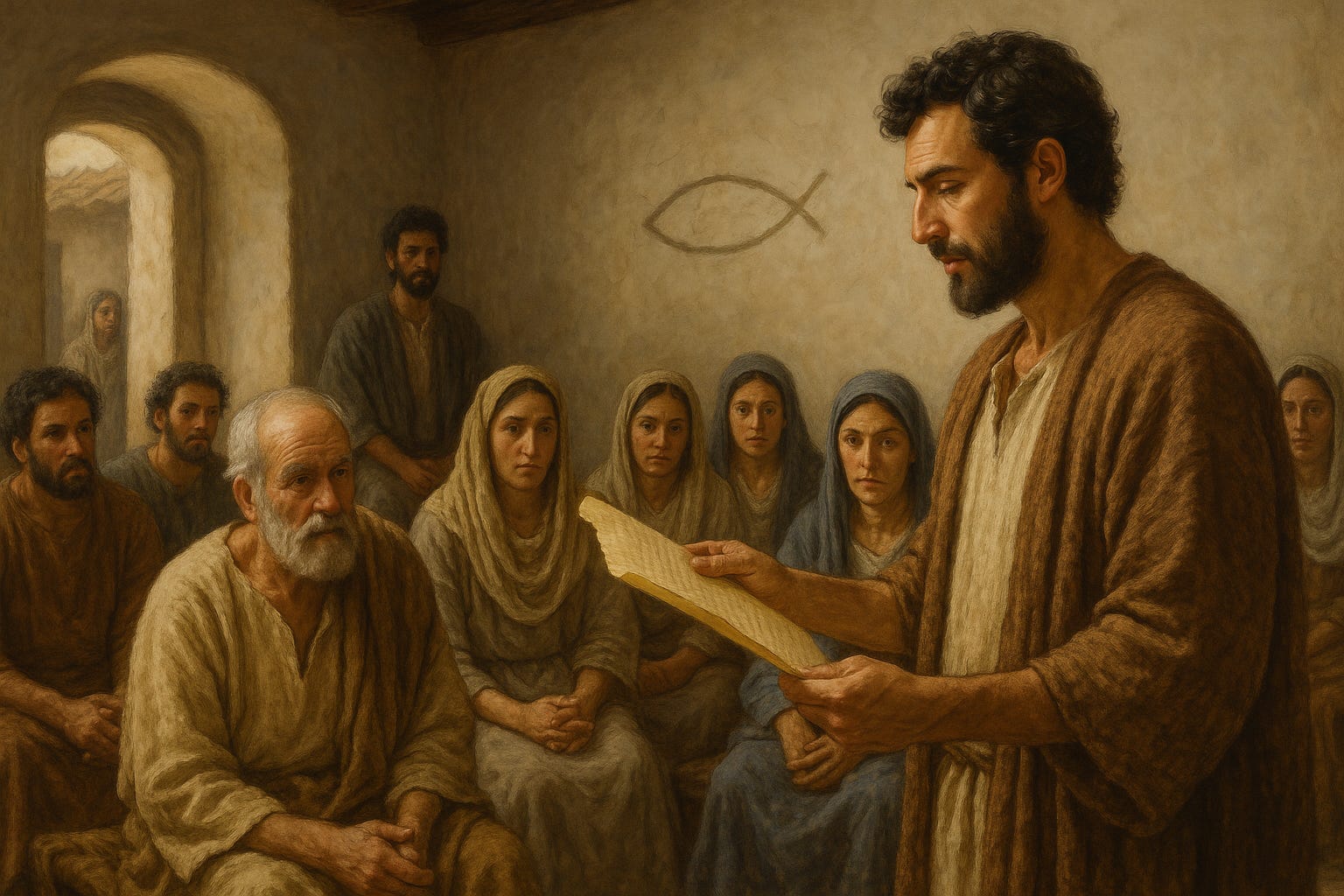
The council’s instructions were written in a letter and hand–delivered through trusted men. The apostles and elders, with the whole church, decided to choose some of their own men and send them to Antioch with Paul and Barnabas. They chose Judas (called Barsabbas) and Silas, men who were leaders among the believers. With them they sent the following letter: The letter was sent to the Gentile believers in Antioch, Syria and Cilicia” (Acts 15:22-23).
Communication through letters was a common practice for conveying important messages in the ancient world. In the New Testament written communication provided guidance to distant congregations; out of the 27 books in the New Testament, 21 of them are letters (also known as epistles) written to churches or church leaders. 13 of the letters are attributed to Paul. Written text stays the same when copied or sent to large groups in different places. They travel farther and last longer than a spoken report.
We have heard that some went out from us without our authorization and disturbed you, troubling your minds by what they said. So we all agreed to choose some men and send them to you with our dear friends Barnabas and Paul—men who have risked their lives for the name of our Lord Jesus Christ. Therefore we are sending Judas and Silas to confirm by word of mouth what we are writing. It seemed good to the Holy Spirit (Acts 15:24-29).
The phrase “went out from us without our authorization “indicate the false teachers were likely members of the Jerusalem church who went out without the authority of the Church leaders. This reflects the early church's struggle with maintaining doctrinal purity as it expanded. The false teaching brought confusion in the Antioch church. Sound doctrine based on unchanging biblical facts keep people firm when culture and feelings shift.
One of the clearest warnings found in Paul’s epistles is the warning about departing from sound doctrine. “Sound doctrine” means teaching that is pure and consistent with God’s truth. Paul repeatedly instructed Timothy to guard, teach, and continue in sound doctrine because false doctrine destroys spiritual stability. He wrote to him “watch your life and doctrine closely. Persevere in them, because if you do, you will save both yourself and your hearers” (1 Tim.4:16).
False doctrine may sound religious but it produces confusion, bondage, and corruption. A believer who is not established in sound doctrine can easily become the victim of persuasive speech, emotional arguments and religious systems. Paul instructed Titus “since an overseer manages God’s household...he must hold firmly to the trustworthy message as it has been taught, so that he can encourage others by sound doctrine and refute those who oppose it” (Titus 1:7-9).
In addition to the witness of Barnabas and Paul, two more witnesses from the home church in Jerusalem would vouch for the authenticity and explain, if necessity, the written instructions. Their resolution “seemed good to the Holy Spirit”. He invisibly presided over the proceedings, affirming that doctrine and practice must align with divine revelation, not cultural pressure. Jesus had promised that the Holy Spirit would guide his people into all truth (John 16:13).
So the men were sent off and went down to Antioch, where they gathered the church together and delivered the letter. The people read it and were glad for its encouraging message. Judas and Silas, who themselves were prophets, said much to encourage and strengthen the believers. After spending some time there, they were sent off by the believers with the blessing of peace to return to those who had sent them (Acts 15:30-33).
The letter from the Jerusalem Council brought joy and encouragement to the Gentile believers. The decision affirmed their inclusion in the body of Christ without the burden of legalistic requirements. Judas and Silas delivered more than a letter; they spoke words that steady hearts and fortify faith. God uses faithful servants, clear teaching, and brotherly love to anchor the church in truth and unity.
We must never do things that are culturally accepted but absolutely forbidden by the scriptures. We must not be so influenced by our culture that we violate God’s holy standards. Our authoritative guide for all faith and practice is God’s Word, which should be taught and learned. Paul and Barnabas stayed in Antioch, “teaching and preaching, with many others also, the word of the Lord.” The last part of the Great Commission is “teaching them to observe all that I have commanded you” ( Matt.28:20).
The church has always been plagued with false teachers like these Judaizers, whose words unsettled the souls of the saints. Paul later warned the Ephesian pastors that from among their ranks, men would arise, “speaking perverse things, to draw away the disciples after them” (Acts 20:30) So we need to be always growing in our knowledge and application of God’s Word, so that false teachers do not plunder our souls.
The Jerusalem church, which was mostly composed of Jews, faced serious cultural conflicts when they began accepting Gentiles into Christianity. If they had not resolved the issues, they would have faced significant difficulties in spreading the Gospel to the Gentile world. If Antioch, a gentile church, would have said “we’ll go our own way regardless of what the Jerusalem says, there would have been a division between the Jewish church and the Gentile church. Disunity would have posed a serious obstacle to the spread of the Gospel of throughout the world.
The story of the Jerusalem Council is located at the very middle of the book of Acts. Chapter 15 is a major turning point;It marks the moment when the early church shifts from a local Jewish group into an open, global faith for all people. From this point onward, the narrative of Acts focuses on Gentile missions led by the Apostle Paul. The church's mission is to reach all nations with the gospel, transcending cultural and ethnic boundaries.
Walk worthy of the vocation wherewith ye are called, With all lowliness and meekness, with longsuffering, forbearing one another in love; Endeavouring to keep the unity of the Spirit in the bond of peace. There is one body, and one Spirit, even as you are called in one hope of your calling; One Lord, one faith, one baptism, One God and Father of all, who is above all, and through all, and in you all” (Eph.4:1-6).


Comments
Post a Comment